Categories
ElementsEd

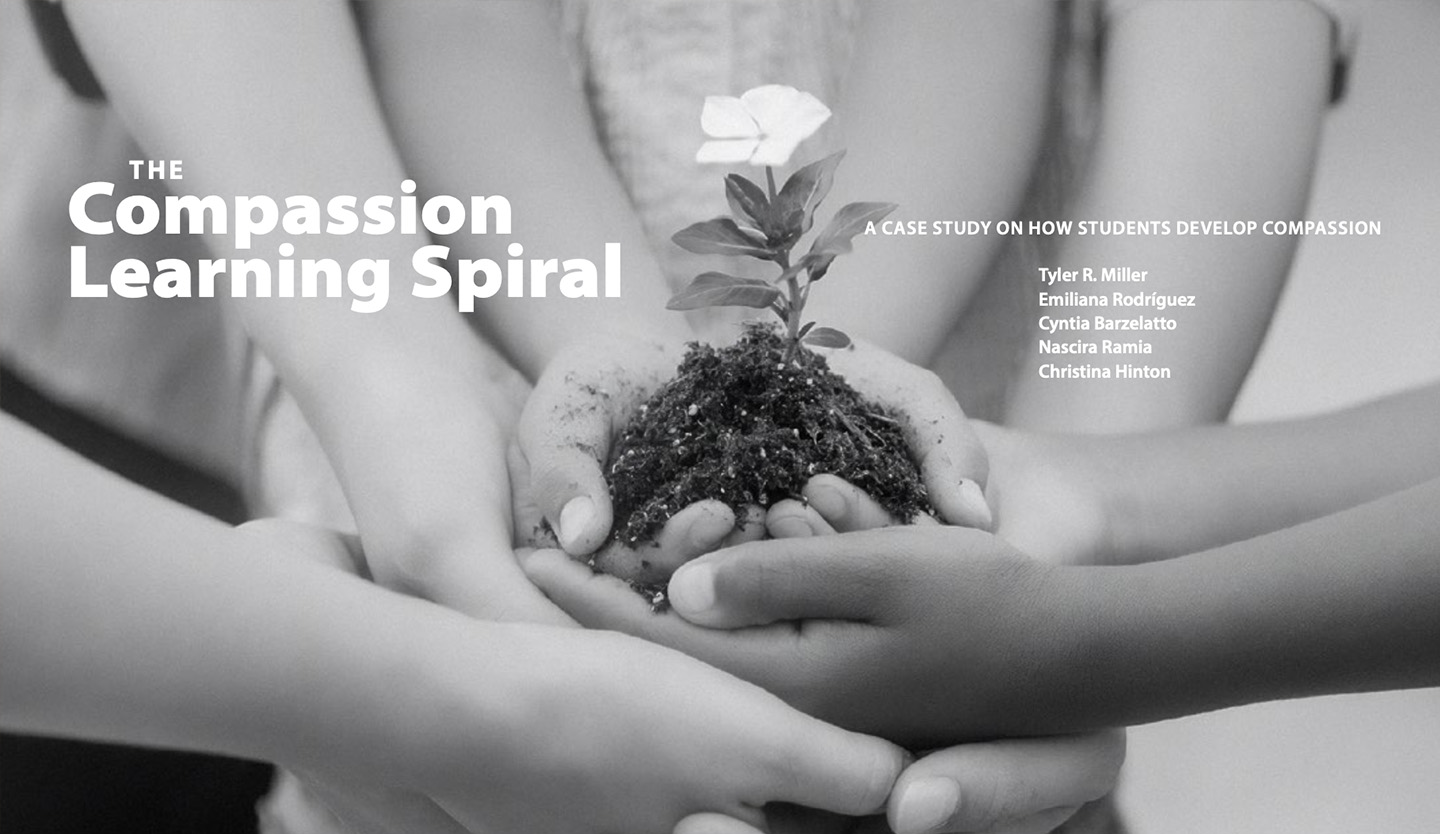
The Compassion Learning Spiral

The Compassion Learning Spiral

A Case Study on How Students Develop Compassion

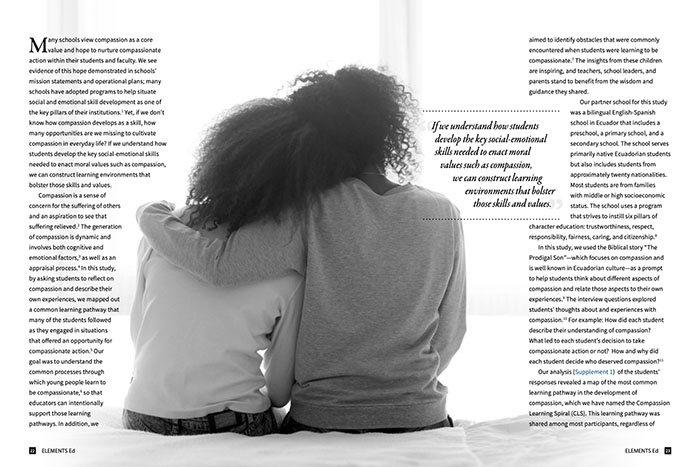
If we understand how students develop the key social-emotional skills needed to enact moral values such as compassion, we can construct learning environments that bolster those skills and values. In this study, the authors map the most common learning pathway in the development of compassion, which they named the Compassion Learning Spiral (CLS): Recognition of Suffering, Evaluation, Action, Unfolding.

The following is an excerpt from the article originally published in ElementsEd Issue 02. The article is written by Tyler R. Miller, Emiliana Rodríguez, Cyntia Barzelatto, Nascira Ramia, and Christina Hinton.

Many schools view compassion as a core value and hope to nurture compassionate action within their students and faculty. We see evidence of this hope demonstrated in schools’ mission statements and operational plans; many schools have adopted programs to help situate social and emotional skill development as one of the key pillars of their institutions. Yet, if we don’t know how compassion develops as a skill, how many opportunities are we missing to cultivate compassion in everyday life? If we understand how students develop the key social-emotional skills needed to enact moral values such as compassion, we can construct learning environments that bolster those skills and values.

Compassion is a sense of concern for the suffering of others and an aspiration to see that suffering relieved. The generation of compassion is dynamic and involves both cognitive and emotional factors, as well as an appraisal process. In this study, by asking students to reflect on compassion and describe their own experiences, we mapped out a common learning pathway that many of the students followed as they engaged in situations that offered an opportunity for compassionate action. Our goal was to understand the common processes through which young people learn to be compassionate, so that educators can intentionally support those learning pathways. In addition, we aimed to identify obstacles that were commonly encountered when students were learning to be compassionate. The insights from these children are inspiring, and teachers, school leaders, and parents stand to benefit from the wisdom and guidance they shared.

Our partner school for this study was a bilingual English-Spanish school in Ecuador that includes a preschool, a primary school, and a secondary school. The school serves primarily native Ecuadorian students but also includes students from approximately twenty nationalities. Most students are from families with middle or high socioeconomic status. The school uses a program that strives to instill six pillars of character education: trustworthiness, respect, responsibility, fairness, caring, and citizenship.

Read the Complete Article
Get ElementsEd Issue 02 Free

Conversations

The Marshall Memo • September 9, 2024
Categories
ElementsEd

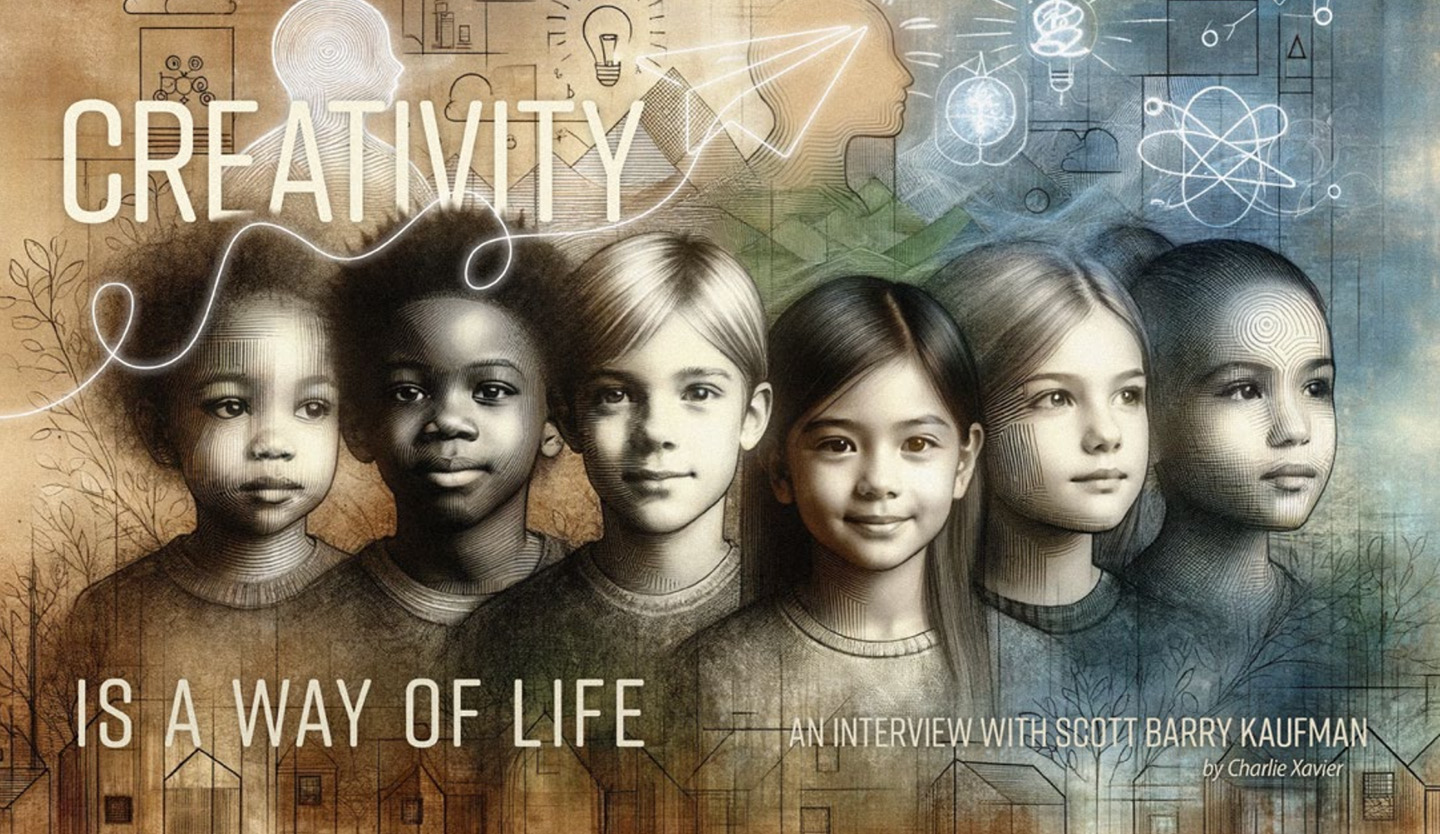
Creativity Is a Way of Life: An Interview with Scott Barry Kaufman

Creativity Is a Way of Life

An Interview with Scott Barry Kaufman by Charlie Xavier

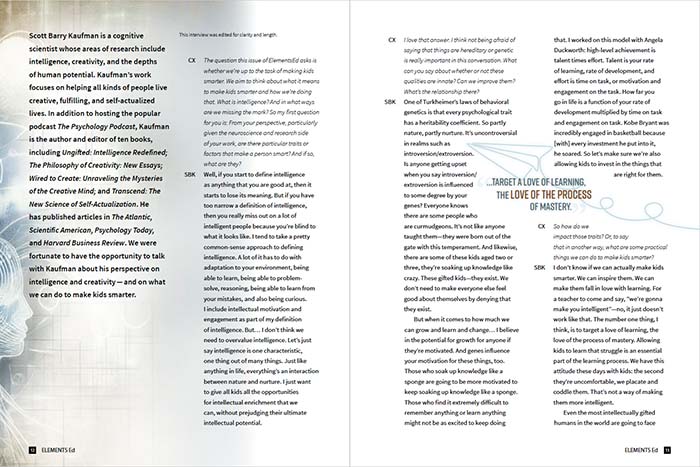
Scott Barry Kaufman is a cognitive scientist whose areas of research include intelligence, creativity, and the depths of human potential. Kaufman’s work focuses on helping all kinds of people live creative, fulfilling, and self-actualized lives. In an interview originally published in ElementsEd Issue 02, Kaufman shared his perspective on intelligence and creativity—and on what we can do to make kids smarter.

The following is an excerpt from the interview.

Charlie Xavier

The question this issue of ElementsEd asks is whether we’re up to the task of making kids smarter. We aim to think about what it means to make kids smarter and how we’re doing that. What is intelligence? And in what ways
are we missing the mark? So my first question for you is: From your perspective, particularly given the neuroscience and research side of your work, are there particular traits or factors that make a person smart? And if so, what are they?

Scott Barry Kaufman

Well, if you start to define intelligence as anything that you are good at, then it starts to lose its meaning. But if you have too narrow a definition of intelligence, then you really miss out on a lot of intelligent people because you’re blind to what it looks like. I tend to take a pretty common-sense approach to defining intelligence. A lot of it has to do with adaptation to your environment, being able to learn, being able to problem solve, reasoning, being able to learn from your mistakes, and also being curious. I include intellectual motivation and engagement as part of my definition of intelligence. But… I don’t think we need to overvalue intelligence. Let’s just say intelligence is one characteristic, one thing out of many things. Just like anything in life, everything’s an interaction between nature and nurture. I just want to give all kids all the opportunities for intellectual enrichment that we can, without prejudging their ultimate intellectual potential.

Charlie Xavier

I love that answer. I think not being afraid of saying that things are hereditary or genetic is really important in this conversation. What can you say about whether or not these qualities are innate? Can we improve them? What’s the relationship there?

Scott Barry Kaufman

One of Turkheimer’s laws of behavioral genetics is that every psychological trait has a heritability coefficient. So partly nature, partly nurture. It’s uncontroversial in realms such as introversion/extroversion. Is anyone getting upset when you say introversion/ extroversion is influenced to some degree by your genes? Everyone knows there are some people who are curmudgeons. It’s not like anyone taught them—they were born out of the gate with this temperament. And likewise, there are some of these kids aged two or three, they’re soaking up knowledge like crazy. These gifted kids—they exist. We don’t need to make everyone else feel good about themselves by denying that they exist.

But when it comes to how much we can grow and learn and change… I believe in the potential for growth for anyone if they’re motivated. And genes influence your motivation for these things, too. Those who soak up knowledge like a sponge are going to be more motivated to keep soaking up knowledge like a sponge. Those who find it extremely difficult to remember anything or learn anything might not be as excited to keep doing that. I worked on this model with Angela Duckworth: high-level achievement is talent times effort. Talent is your rate of learning, rate of development, and effort is time on task, or motivation and engagement on the task. How far you go in life is a function of your rate of development multiplied by time on task and engagement on task. Kobe Bryant was incredibly engaged in basketball because [with] every investment he put into it, he soared. So let’s make sure we’re also allowing kids to invest in the things that are right for them.

Charlie Xavier

So how do we impact those traits? Or, to say that in another way, what are some practical things we can do to make kids smarter?

Scott Barry Kaufman

I don’t know if we can actually make kids smarter. We can inspire them. We can make them fall in love with learning. For a teacher to come and say, “we’re gonna make you intelligent”—no, it just doesn’t work like that. The number one thing, I think, is to target a love of learning, the love of the process of mastery. Allowing kids to learn that struggle is an essential part of the learning process. We have this attitude these days with kids: the second they’re uncomfortable, we placate and coddle them. That’s not a way of making them more intelligent.

Even the most intellectually gifted humans in the world are going to face things that are going to challenge them. Einstein struggled with things and had to persevere. So, it really is having them fall in love with the whole process. And, showing the reward that comes from the mastery process—maybe having some project-based reward, where they can demonstrate and have pride in the process they went through. Also, the teacher or the modeler can model enthusiasm. Inspiring mentors are really important; so is showing examples of people throughout history who have changed the world using some of their learning or knowledge. Another way is to help connect the learning material to something that gives them some meaning for what they’re doing.

Read the Complete Interview
Get ElementsEd Issue 02 Free

Conversations

The Pscyhology Podcast with Scott Barry Kaufman • November 21, 2019

Scientific American • January 4, 2019